Top Down vs Bottom Up Estimating in Construction
How Unit Rate and Resource-Based Estimating Support Estimate Maturity
What is Top Down and Bottom Up Estimating?
Top down and bottom up estimating are two core approaches used in construction to forecast cost and, increasingly, carbon. Top down estimating, often referred to as unit rate estimating, uses high-level metrics such as cost per square metre or cost per element. Bottom up estimating, also known as resource-based estimating, builds the estimate from detailed components including labour, plant, materials, and subcontract inputs.
In modern construction workflows, these approaches are not alternatives. They are complementary. Projects naturally evolve from high-level assumptions to detailed, data-driven estimates as more information becomes available. The key is having a structured approach that supports both methods and enables a smooth transition between them.
Why Estimating Approaches Must Evolve in 2026
Construction projects are becoming more complex, whilst expectations around accuracy, transparency, and sustainability continue to increase. Early-stage estimates are still required quickly, often with limited design information. However, as projects progress, stakeholders expect increasing levels of detail and confidence.
This makes the ability to move from top down to bottom up estimating essential. It allows teams to respond quickly at concept stage while progressively improving accuracy and reliability as designs develop.
Key drivers include:
Increasing demand for early-stage feasibility and cost planning
The need for greater accuracy at tender stage
Carbon reporting requirements alongside cost
Client expectations for transparency and auditability
The need to reduce risk and rework
What is Top Down (Unit Rate) Estimating?
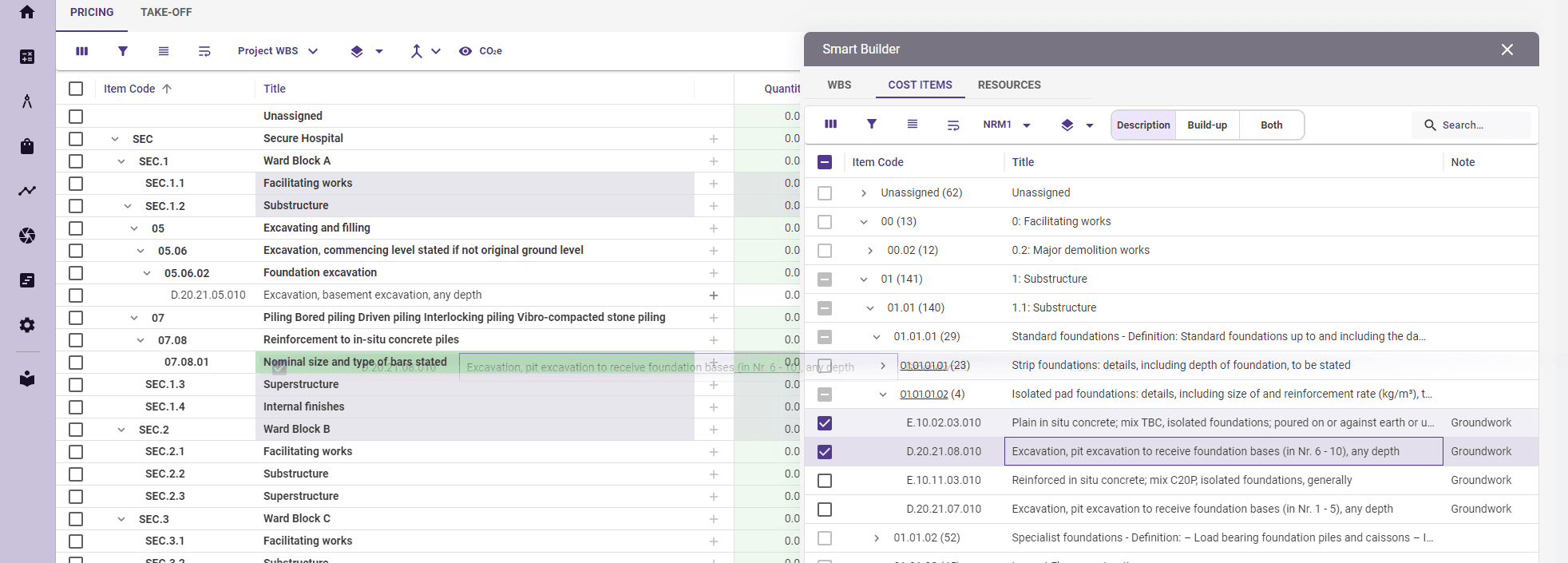
Top down estimating uses historical data, benchmarks, or standard rates to produce a high-level estimate. It is typically applied in the early stages of a project when detailed design information is not yet available.
This approach enables estimators to quickly generate cost plans using known metrics such as area, volume, or functional units. It is particularly effective for feasibility studies and early option comparisons.
Common examples of top down estimating:
Cost per square metre for buildings
Cost per linear metre for infrastructure
Elemental cost planning based on historical data
Benchmarking against similar projects
Benefits of Top Down Estimating
Rapid early-stage estimates
Useful for feasibility and option comparison
Requires limited design information
Enables quick decision making
Limitations
Lower accuracy compared to detailed methods
Relies heavily on assumptions and historical data
Limited visibility of underlying cost drivers
What is Bottom Up (Resource-Based) Estimating?
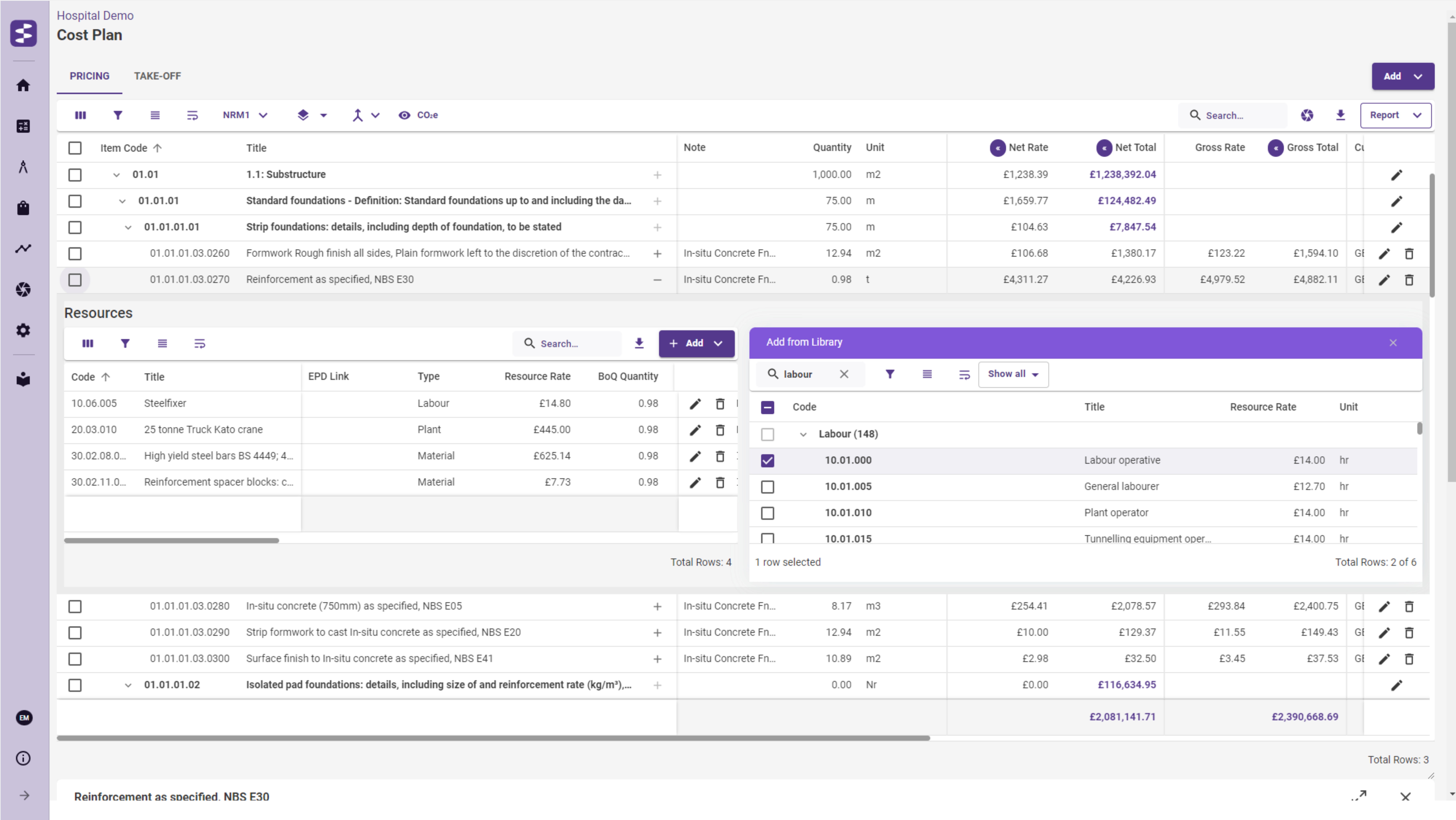
Bottom up estimating takes a detailed approach by building the estimate from individual resources. Each part of the project is broken down into labour, plant, materials, and subcontract elements, with quantities and rates applied at a granular level.
This method provides a far more accurate and transparent estimate, as it reflects how the project will actually be delivered.
What resource-based estimating includes:
Detailed quantities from 2D and 3D takeoff
Labour outputs and productivity rates
Material specifications and quantities
Plant usage and durations
Subcontract pricing
Benefits of Bottom Up Estimating
High level of accuracy and detail
Clear visibility of cost drivers
Supports both cost and carbon calculations
Enables auditability and validation
Limitations
More time-intensive to produce
Requires detailed design information
Dependent on high-quality data
The Journey from Top Down to Bottom Up
Estimating is not a single step. It is a process that evolves as a project progresses. Early estimates are necessarily high-level, but as more information becomes available, they should become increasingly detailed and reliable.
This progression is known as estimate maturity.
At concept stage, top down methods dominate. As the design develops, hybrid approaches emerge. By the time a project reaches tender stage, bottom up estimating becomes the primary method.
Typical estimating progression:
Concept stage: High-level unit rates and benchmarks
Design development: Combination of unit rates and detailed build-ups
Tender stage: Fully detailed resource-based estimates
Pre-construction: Validation, refinement, and alignment with the supply chain
The Challenge: Managing Estimate Maturity
One of the biggest challenges in construction estimating is managing this transition effectively. Many organisations rely on disconnected tools or processes, making it difficult to carry data forward as the estimate evolves.
This often results in:
Rework when moving between stages
Loss of assumptions and supporting data
Inconsistent outputs across project phases
Limited visibility of how estimates have developed
Without a connected approach, the benefits of both top down and bottom up estimating are significantly reduced.
How Sterling Supports Both Approaches
Modern estimating platforms such as Sterling are designed to support the full estimating lifecycle, from early-stage unit rate estimates through to detailed resource-based build-ups.
Rather than forcing a choice between approaches, Sterling enables both within a single environment. Estimators can start with high-level assumptions and progressively refine them as more information becomes available, without needing to rebuild the estimate.
Key capabilities include:
Creating high-level cost plans using unit rates and benchmarks
Transitioning seamlessly to detailed resource-based estimates
Linking quantities directly to labour, plant, and materials
Supporting both cost and carbon outputs from the same data
Maintaining a clear audit trail of estimate development
This ensures continuity across project stages and significantly reduces duplication and rework.
Integrating Cost, Carbon, and Estimate Maturity
As cost and carbon estimating become more closely linked, the importance of estimate maturity increases. Early-stage carbon estimates may be based on high-level assumptions, but these must evolve into detailed, resource-based calculations as the project develops.
An integrated approach enables:
Carbon to be estimated alongside cost at every stage
Assumptions to be refined as better data becomes available
Consistent reporting across the project lifecycle
Alignment between commercial and sustainability teams
This ensures that both cost and carbon remain accurate, aligned, and relevant throughout.
Best Practices for Managing Estimating Approaches
To maximise the value of both top down and bottom up estimating, organisations should adopt a structured and consistent approach.
Recommended best practices:
Start with high-level estimates but plan for refinement
Maintain clear links between assumptions and detailed data
Avoid rebuilding estimates when moving between stages
Use consistent structures and classification systems
Align cost and carbon data from the outset
Top down and bottom up estimating are both essential to modern construction. Each plays a critical role at different stages of a project, and the real value comes from using them together within a connected workflow.
In 2026, the focus is not on choosing one approach over the other. It is on enabling a smooth transition between them, improving estimate maturity, and ensuring that both cost and carbon are accurately represented at every stage.
Platforms like Sterling make this possible by providing a single, integrated environment for the entire estimating process.