
The Estimate Lives with the Project
From early cost planning to a resource driven estimate, then into living project delivery.
One Estimate. Every Stage. The Estimate Lives with the Project.
Why the estimate should never die at a stage gate
An estimate should not be something that is created, approved and then gradually becomes disconnected from the project it was intended to support.
Too often, an estimate is developed for a particular stage gate, issued as a report or spreadsheet and then effectively frozen in time. The project continues to evolve. The design changes. Quantities change. Procurement decisions are made. Programmes move. Market conditions change. Variations occur. Actual costs begin to emerge.
But the estimate that helped inform the original decision can quickly become disconnected from that reality.
At Sterling, we believe the estimate should live with the project. It should begin early, mature in detail and certainty, remain controlled through clearly defined stage gates and statuses, and then continue into live project delivery.
The aim is not to create a new estimate at every stage. It is to maintain one continuous estimating history that develops with the project, while retaining the formal positions used for governance and approval.
One estimate through the project lifecycle
The diagram below illustrates how Sterling modules can support the estimate across the RIBA stage gates, while keeping estimating, takeoff, bid packages, forecasting and lifecycle information connected as the project develops.
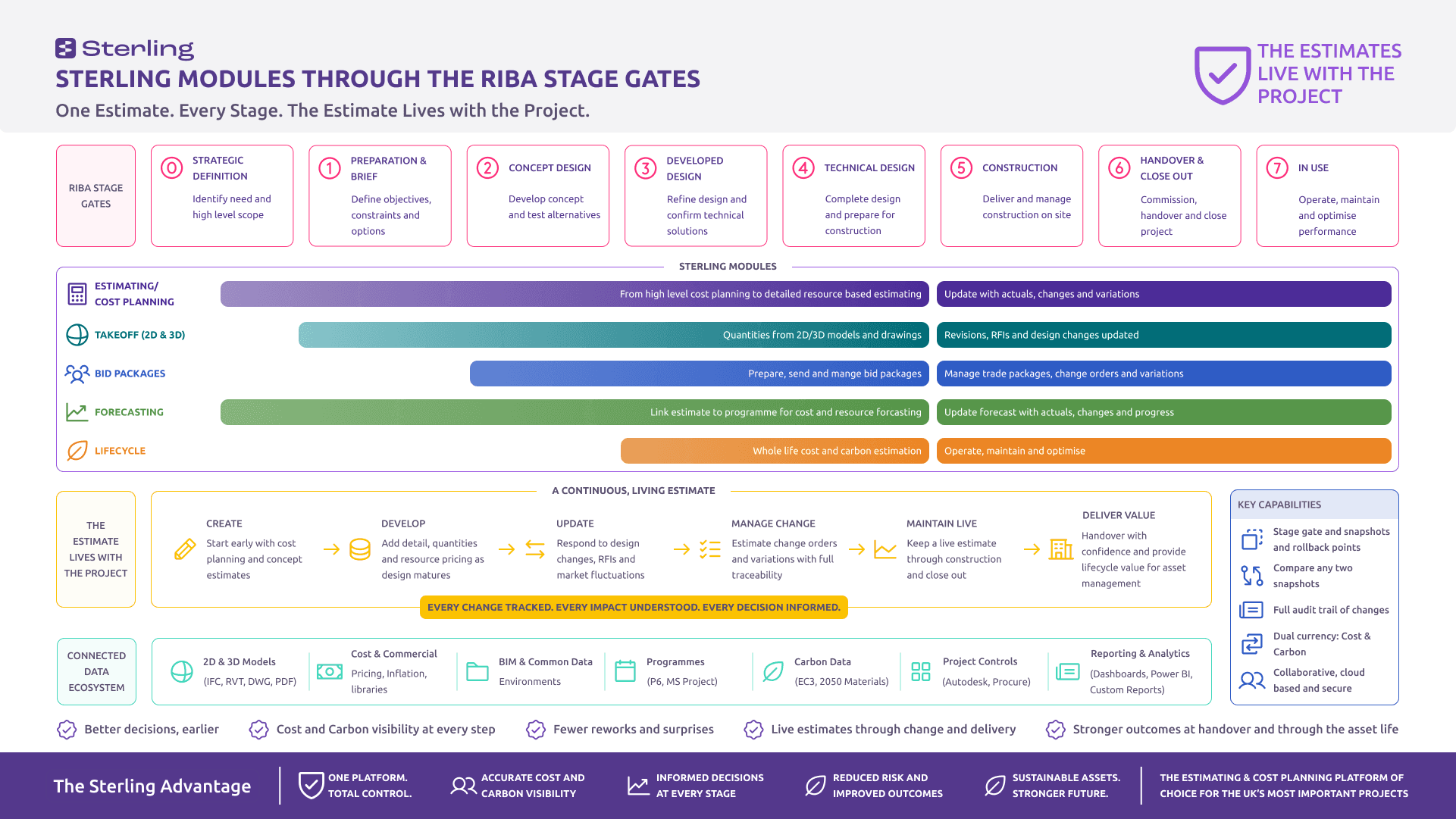
From early cost plan to living project delivery
The estimate should begin early and mature with the project.
At the earliest stages, that may mean a high level cost plan built from benchmarks, assumptions and limited design information. As the project develops, Sterling allows that same estimate to be progressively enriched with quantities, detailed cost items, activities, resources and supply chain information, evolving into a fully resource driven estimate.
Crucially, that development is tracked throughout. Stage gates, statuses, snapshots and audit history provide a clear record of how the estimate has changed, what was Work in Progress, what was submitted, what was approved and what information supported each decision.
The estimate does not then stop once the detailed estimate is complete. It continues into living project delivery, responding to design changes, updated takeoff quantities, procurement decisions, programme movements, actuals, variations and progress. Where appropriate, Sterling can connect with project controls and planning solutions so the estimate remains part of the wider delivery environment.
The journey is continuous: Early Cost Plan → Developing Estimate → Resource Driven Estimate → Approved Baseline → Living Project Delivery Estimate → Handover and Lifecycle.
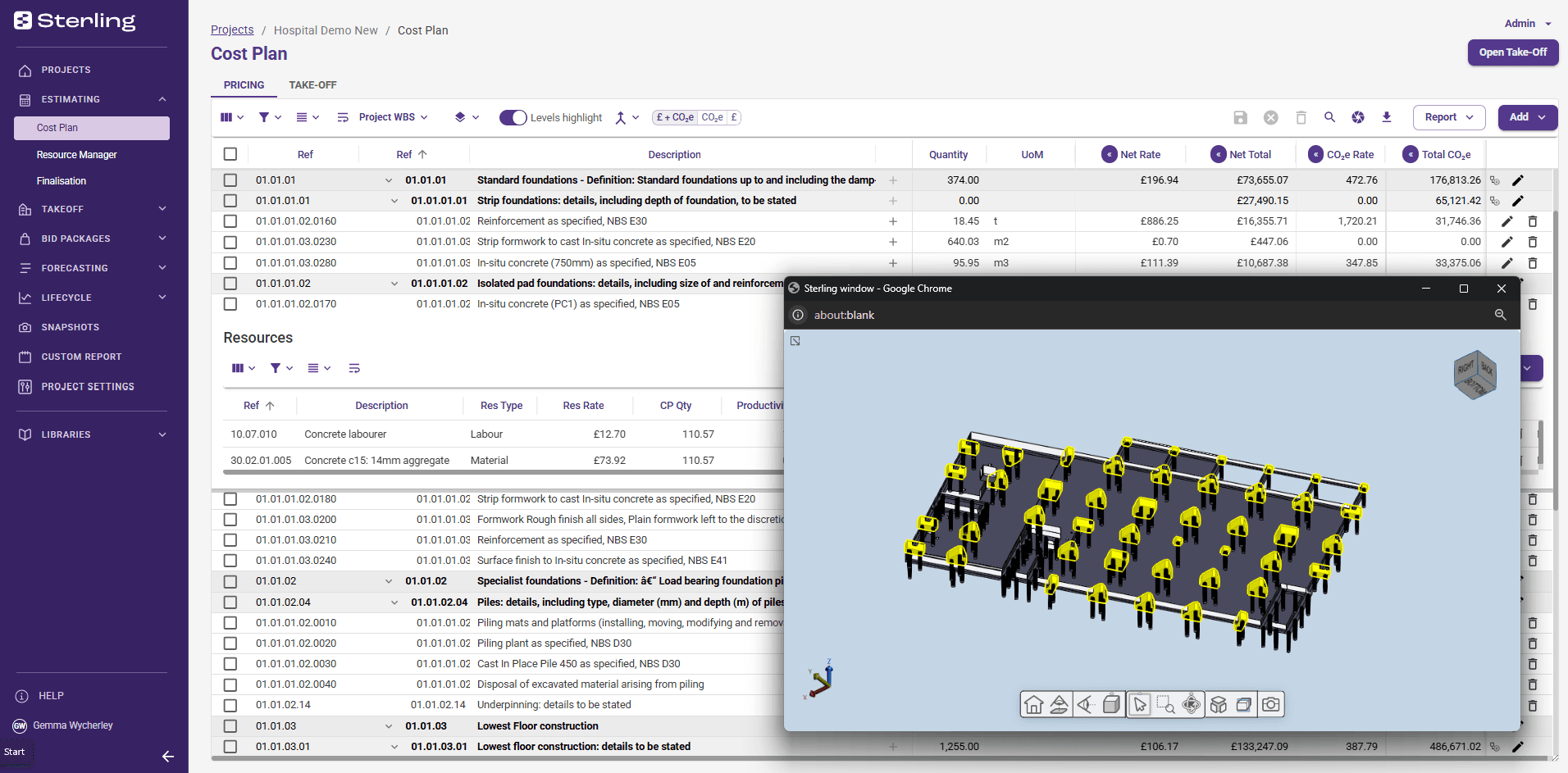
Stage gates provide control without stopping the estimate
A living estimate does not mean an uncontrolled estimate. Projects still need formal governance.
At any point, organisations need to know not only the value of the current estimate, but also what stage the project has reached, whether the estimate is still being developed, whether it has been submitted or approved, and what information supported a particular stage gate decision.
Sterling can be used to manage the estimate through defined project stages and statuses. For example:
RIBA Stage 3 – Work in Progress
RIBA Stage 3.1 Option Engineering (Snap Shots)
RIBA Stage 3.2 Option Engineering (Snap Shots)
RIBA Stage 3 – Submitted
RIBA Stage 3 – Reviewed
RIBA Stage 3 – Approved
RIBA Stage 4 – Work in Progress
The same principle can be applied to an organisation's own project lifecycle, assurance gateways or investment approval process. The important point is that the estimate continues to live while its formal status remains clear.
Know exactly where the estimate is in its lifecycle
On a complex project, simply having a “latest estimate” is not enough. Teams need to understand the context behind that number.
A £100 million estimate at RIBA Stage 2 represents a very different level of design maturity, quantity certainty, scope definition and commercial confidence from a £100 million estimate at RIBA Stage 4. The value may be the same, but the information behind it is not.
That is why the stage and status of the estimate should form part of the estimate itself.
Sterling provides a structured way of identifying where an estimate sits within the project lifecycle, helping teams distinguish between information that is:
In Development – the estimate is being created and remains subject to significant change as assumptions, scope and design information develop.
Work in Progress – the estimate is actively being developed for a defined stage or gateway, with quantities, rates, resources and assumptions continuing to be refined. This may have multiple iterations (Snap Shots) to determine the best one to carry forward
Submitted – the estimate has reached a controlled point and has been formally issued for review, assurance or approval.
Reviewed – the estimate has been through an agreed review or assurance process and resulting comments or actions can be understood in context.
Approved – the estimate represents an accepted position at a defined project stage or governance gateway.
Superseded – the estimate remains part of the project history but has been replaced by a later controlled position.
This provides far more context than simply labelling something Version 17, Final, or Final Final Approved. On large projects, where multiple teams may be developing estimates over several years, relying on file names, folder structures and spreadsheet versions can quickly become difficult to manage.
Sterling instead allows the estimate to sit within a structured lifecycle. A project team can understand not only what the current estimate is, but what stage it is at, whether it has been submitted, what was approved previously and what has changed since that point.
For example, RIBA Stage 3 – Work in Progress may progress to RIBA Stage 3 – Submitted, then Reviewed and Approved, before the living estimate moves forward into RIBA Stage 4 – Work in Progress. The estimate continues to develop, but its position in the project lifecycle always remains clear.
Stage gates are checkpoints, not endpoints
Stage gates remain essential to effective project governance. They provide controlled points where scope, design maturity, cost, carbon, programme, risk and other project information can be reviewed before a decision is made to move forward.
But a stage gate should represent a checkpoint in the life of the estimate, not the point at which the estimate stops developing.
When a project reaches an important gateway, Sterling can retain the estimate at that point as a controlled snapshot. That snapshot records what was known, what assumptions were being used, what quantities and rates supported the estimate, and what cost and carbon position was submitted or approved at that moment in time.
The living estimate can then continue into the next stage. This creates two important views of the project at the same time:
The historical position – what did we know and approve at the stage gate?
The live position – what do we know now?
Both are important. The historical position provides the governance record. The live position supports current decision making.
For example, if a project completed RIBA Stage 3 with an approved estimate of £100 million, that position should remain available as a controlled reference point. As the project moves into RIBA Stage 4, the design may continue to develop, quantities may change, specifications may be refined, procurement information may become available and the programme may move.
The live estimate might therefore move from £100 million to £104 million. The key question should not simply be 'why is the estimate now £104 million?' The more useful questions are what changed since the approved stage gate, which design decisions created the movement, whether the change was caused by quantity, rate, scope or programme/schedule, what happened to carbon at the same time, and whether the movement is reflected in the current forecast.
This is where stage gates become more than reporting milestones. They become structured reference points in the continuous history of the project.
As the project moves through successive stages, Sterling can retain important controlled positions such as Stage 2 Approved, Stage 3 Submitted, Stage 3 Approved Snapshot, Stage 4 Work in Progress, Stage 4 Approved Snapshot, Construction Baseline and Current Delivery Position.
The result is not a series of disconnected estimates. It is one continuous estimating history, with controlled governance points throughout.
Sterling combines the flexibility of a living estimate with the discipline of controlled project governance. The estimate continues to evolve, while every important submitted and approved position remains available as part of the project's auditable history.
Stage gates do not stop the estimate. They anchor it.
Connect the estimate directly to the developing design
One of the most important parts of maintaining a living estimate is the relationship between design, quantity, cost and carbon.
As drawings and models develop, the commercial impact needs to be understood quickly. A design change may alter quantities, specifications, resource requirements, construction methodology and ultimately both cost and carbon.
Traditionally, that can create a significant amount of rework. Revised drawings are issued, quantities are measured again, spreadsheets are updated, assumptions are checked and the cost plan is rebuilt or reconciled against the previous version.
Sterling is designed to reduce that break in continuity.
By bringing estimating and 2D and 3D takeoff into the same environment, quantities can be linked directly to the estimate and remain connected to the underlying design information.
That means when drawings or models are revised, teams do not necessarily need to start the takeoff process again from scratch. Existing takeoff information can be reviewed and updated against the latest design, with revised quantities feeding back into the live estimate. This helps maintain continuity between one design iteration and the next while preserving the commercial structure already developed around the estimate.
The benefit is not simply faster measurement. It is the ability to see the impact of design change much earlier.
As quantities are updated, the effect on the estimate can become visible almost in real time. Teams can understand whether a design revision is increasing or reducing cost, how it affects resource requirements, and what the corresponding carbon impact may be.
This creates a much tighter feedback loop between design and commercial decision making. Instead of waiting for the next formal cost plan or stage gate submission to understand the effect of a change, project teams can begin to see that impact while the design is still evolving.
For example, a change to a structural element, façade system, plant selection or material specification may alter quantities within the linked takeoff. Those quantity changes can then flow through the estimating structure and update the associated cost and carbon calculations.
This allows teams to ask what changed in the design, which quantities changed as a result, what that does to cost and carbon, and how the new position compares with the last submitted or approved stage gate.
This is particularly valuable when moving from a RIBA Stage 3 – Submitted position into RIBA Stage 4 – Work in Progress. The Stage 3 position remains available as the reference point, while the live estimate continues to develop using the latest drawings and models.
By maintaining the connection between the estimate and the developing design, Sterling helps move estimating away from periodic remeasurement and reconciliation towards a more continuous, responsive process.
The estimate does not wait for the design to finish. It develops with it and enhances and informs design potentially before all the changes are created
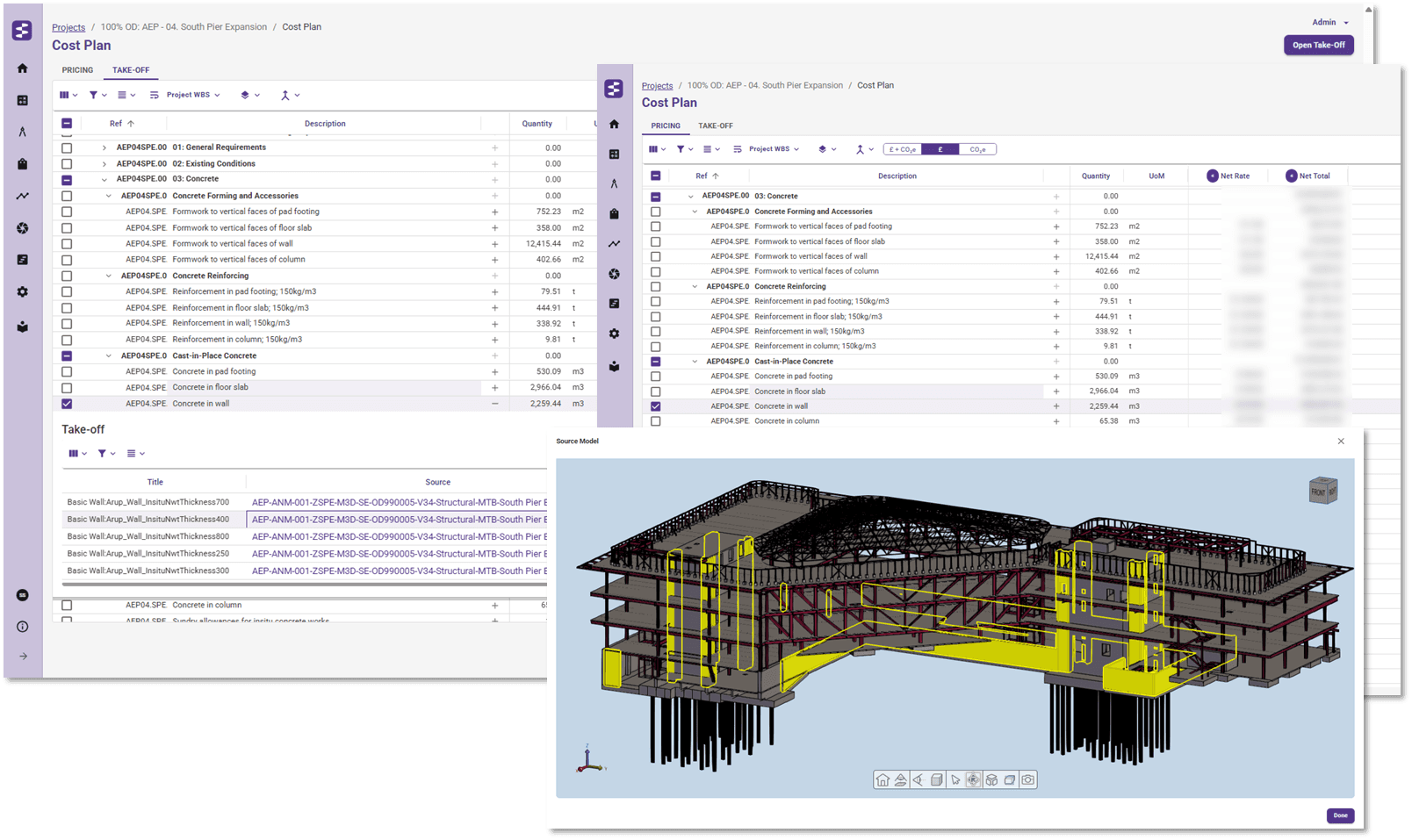
Respond to change instead of periodically rebuilding the estimate
Design development is rarely linear. Drawings are revised, models change, RFIs are raised, specifications develop, alternatives are considered and quantities move.
A traditional process often responds by periodically producing another cost plan. A living estimate works differently: new design information can update the estimate as it becomes available, with revised takeoff quantities and commercial impacts brought into the same continuous record.
This enables teams to understand not only what the estimate is now, but what changed since the last controlled stage gate and why.
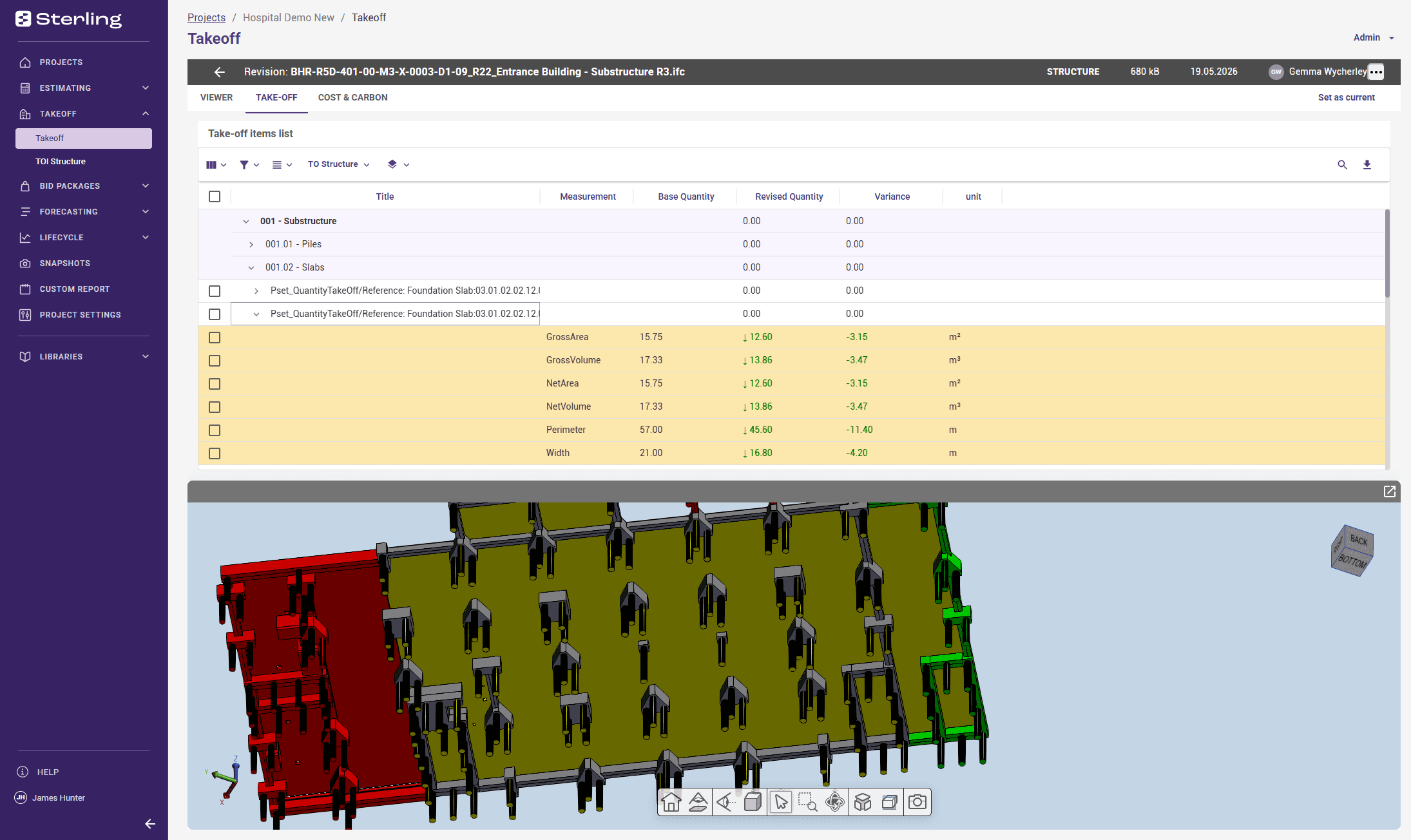
Compare where you were with where you are now
Stage gate snapshots provide reference points against which the current estimate can be compared. Sterling's snapshot capability allows teams to retain key points in the estimate's history and compare positions over time.
Stage 2 and Stage 3
Stage 3 and Stage 4
Tender and award
Approved budget and current forecast
Construction baseline and latest position
The estimate therefore becomes more than a current total. It becomes a structured record of how project decisions have affected cost and carbon throughout the lifecycle.
Connect the living estimate to programme and project controls
As projects move towards technical design and construction, the relationship between estimating and programme information becomes increasingly important. The estimate should not exist independently from how and when the project will actually be delivered.
Sterling Forecasting enables the estimate to be linked to programme information so cost and resources can be considered over time. Where appropriate, Sterling can also exchange information with established planning and project controls solutions, including Primavera P6 and Microsoft Project, helping estimating, programme and forecasting information form part of a wider connected project controls environment.
The aim is not to replace every specialist system involved in delivery. It is to keep the estimate connected to the information that affects it.
Keep the estimate alive through construction
Once construction starts, the estimate still has an important role. Approved stage gate positions and baselines provide the reference against which change, actuals, progress and emerging forecasts can be understood.
During delivery, the live estimate can continue to respond to:
Actual costs and progress
Design revisions
Variations and change orders
Revised takeoff quantities
Programme changes
Procurement information
Market movements
Updated resource assumptions
The estimate therefore evolves from a preconstruction deliverable into part of an ongoing commercial and project controls process. Teams can understand not only what the project was expected to cost, but how and why the current position differs from earlier approved positions.
Cost and carbon evolve together
The same principle applies to carbon.
As the design develops, decisions that affect cost will often affect carbon at the same time. A change in material, quantity, specification, construction methodology, transport requirement or programme can alter both the financial and carbon position of the project.
Sterling treats cost and carbon together within the estimating process, rather than managing carbon as a separate exercise undertaken after the estimate has been produced. This means both can develop as the project develops, using the same underlying quantities, resources and project structures.
At the early stages, carbon information can be considered alongside high level cost planning and optioneering. As the design matures and more detailed quantities and resource information become available, both cost and carbon can become progressively more detailed and evidence based.
This is particularly valuable at formal stage gates. A project team can understand not only the cost position at, for example, RIBA Stage 3 – Submitted, but also the corresponding carbon position. As the project moves into the next stage, design development and change can then be assessed against that previous position.
If a design alternative is proposed, Sterling can therefore help teams ask two questions together: what does this change do to cost, and what does this change do to carbon?
That provides a stronger basis for value engineering and option assessment, because the lowest capital cost solution may not always provide the best carbon or whole life outcome.
Carbon information can also be connected to the wider data ecosystem. Sterling can incorporate carbon information from sources such as EC3 and 2050 Materials, including product and EPD based data, while retaining traceability back to the underlying source and assumptions.
As the project progresses into delivery, the carbon position can continue to evolve alongside the cost position. Changes to materials, quantities, procurement decisions, construction approaches and other project assumptions can be reflected in the live estimate rather than carbon becoming a static assessment produced at an earlier stage.
The same principle can then extend beyond embodied carbon into the wider asset lifecycle, considering areas such as transportation, construction, operation, maintenance, renewal and end of life alongside whole life cost.
The result is a continuous view of cost and carbon from early decision making through design, delivery and into the life of the asset.
One project. One developing estimate. Cost and carbon evolving together at every stage.
The estimate continues through handover and into the asset lifecycle
RIBA Stage 4 should not be the end of the estimating process, and nor should the start of construction. The living estimate can continue through RIBA Stage 5 Construction, Stage 6 Handover and Close Out, and potentially into Stage 7 In Use.
By handover, the estimate has been enhanced to replicate what has actually happened and contains a significant body of structured knowledge: quantities, resources, costs, carbon, changes, programme information, procurement decisions, stage gate positions, assumptions and the reasons behind change.
Sterling Lifecycle extends this thinking into whole life cost and carbon, allowing information developed during planning and delivery to support maintenance, renewals, operations and future investment decisions. The estimate becomes part of the knowledge handed over with the asset and will reflect the potential impact on the project going forward.
A connected estimating and project controls ecosystem
No major project operates with a single software application. Design teams use BIM and Common Data Environments. Planners use programme tools. Commercial and project controls teams use specialist platforms. Organisations increasingly use central reporting and analytics environments.
Sterling is designed to operate within that wider ecosystem. Depending on the client environment, information can be exchanged across 2D and 3D models, BIM and Common Data Environments, cost and commercial data, programmes, carbon data sources, project controls systems and reporting environments such as Power BI.
The objective is simple: keep the estimate connected to the project information that changes it.
From a static estimate to a continuous commercial record
A traditional estimate tells you what was believed at a point in time.
A living estimate can tell you where the project started, what stage it was at, what was Work in Progress, what was submitted, what was approved, how the design developed, what changed, why it changed, what those changes did to cost and carbon, and where the project stands today.
The process becomes: Create. Develop. Stage Gate. Update. Manage Change. Maintain Live. Deliver Value.
Throughout that process, Sterling maintains the current live position while retaining the history of previous decisions.
The estimate should never die
Projects continuously evolve. The information used to make decisions about them should evolve as well.
An estimate should not disappear into a spreadsheet archive once a stage gate has been passed. It should move with the project from one controlled stage to the next, retaining each important Work in Progress, Submitted and Approved position while continuing to respond to design, quantities, programme, procurement, change and delivery.
That is the principle behind Sterling's approach: a continuous estimate that increases in detail and certainty as the project progresses, while retaining the history of every important decision along the way.
The estimate should never die. It should live, develop and change with the project, while every stage gate provides a controlled and auditable point in its history.
One Estimate. Every Stage. The Estimate Lives with the Project, Data is King and the right data at the right time can save an awful amount of pain
